


The Radogoszcz Martyrdom Branch is a memorial site dedicated to the victims of the German occupation of the city and the largest museum in Łódź devoted to the subject of World War II.
Between 1939 and 1945, the former factory building of Samuel Abbe served first as a transit camp and later as a prison for residents of the Wartheland who violated German occupation laws. On the night of January 17–18, 1945, just before the Red Army entered the city, the Germans liquidated the facility, murdering nearly all of the men imprisoned there. They set the prison on fire and positioned a machine gun at its only exit. More than 1,000 people were killed in the massacre.
The museum houses a permanent exhibition entitled “They Were Taken by Fire… The Hell of the Radogoszcz Prison in Light of the Fate of the Wartheland’s Population during World War II.” The exhibition takes a modern approach to this extremely difficult subject. In its first section, visitors can see a life-size model of a Lilpop tram, a café table, and showcases arranged as shop windows from the occupation period. The displayed objects show how Nazi ideology and symbolism sought to infiltrate every aspect of daily life — from plates and carafes to items of clothing.
The second part recalls the history of Abbe’s factory buildings. A few newspaper clippings, photographs, and a large-scale model of the site during the occupation introduce the most moving section of the exhibition.
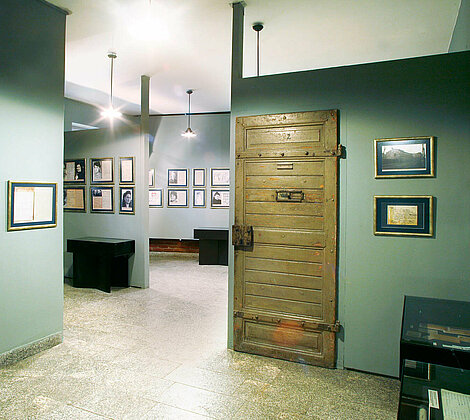
In the third room, visitors encounter a reconstructed prison cell, wooden bunks, an infirmary, and the silhouettes of the perpetrators. The exhibition culminates in two rooms focusing on the Radogoszcz Massacre of 1945 — its preparation, brutal execution, and tragic finale: the murder of over 1,000 people on the eve of Łódź’s liberation from Nazi rule. The display also serves as a contemporary tribute to all those murdered in the Radogoszcz facility.
In the staircase of the former prison building — the only part that survived the fire — visitors can now see the temporary exhibition “Memory of the Ruins”, opened in 2025. Through image, sound, and light, it evokes memories of the former prison, recalling the people once held there and their emotions — longing for family, fear of the future, and hope for freedom. It honors those whose memory has overcome both fire and time, enduring among the ruins of the burnt prison.
Also worth visiting is the outdoor area surrounding the former prison buildings, open to visitors free of charge. During the occupation, this space served both as the roll-call square and as a site of executions. The tragic history is commemorated by a moving bas-relief on the exhibition building’s façade, the partially preserved ruins of the burned factory structures, and a sarcophagus placed on a mound made of earth mixed with the ashes of the murdered victims.

![[Translate to Angielski:] Fot. P. Miłek](/files/public/_processed_/8/c/csm__2021__Muzeum_Kinematografii__fot_P._Milek___14__72a62ab483.jpg "[Translate to Angielski:] Muzeum Kinematografii")
![[Translate to Angielski:] muzeum sztuki ms1 łódź](/files/public/_processed_/a/b/csm_muzeum_sztuki_ms1_lodz_bfa376b3b2.jpg "[Translate to Angielski:]")